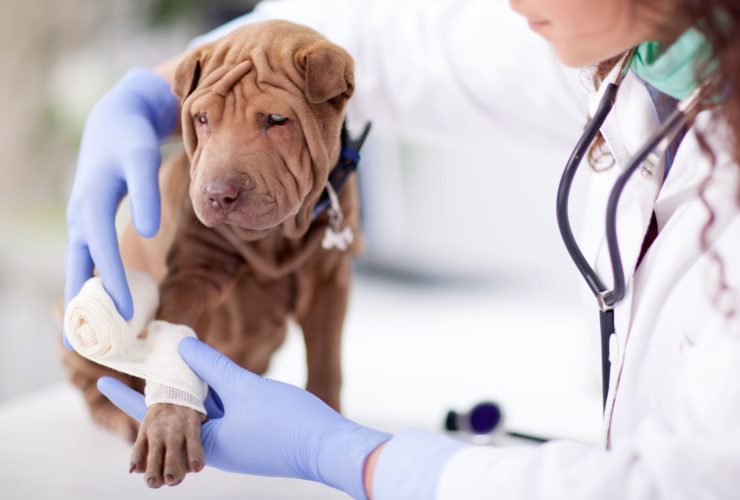
Leo is a large breed dog who has had intermittent lameness in his front legs for most of his life. As a puppy it was easy to think Leo had “growing problems”, “he is such a big dog”, “besides, he does not complain, it must not hurt, he is only lame”.
We have an issue here, when a dog is lame is because it hurts. He does not have to whine or cry in pain, but it hurts, if it didn´t hurt he would walk properly without lameness.
A dog (or a person) can have an episode of lameness due to a traumatism but it would be highly unlikely for him to frequently hit the same joint. If it happens often, we have to look for an explanation other than trauma.
Leo is five years old now, about 70 pounds heavy and suffers DJD (Degenerative Joint Disease, arthrosis) in both elbows, his left one is worse than the right one. “There you have it, he is lame because of the DJD”. Well, not exactly.
Leo has elbow dysplasia which now that he is 5 years old, and (mainly) a 70-pound big boy, has evolved into DJD. To be specific, Leo´s problem is called fragmented medial coronoid process (FMCP), lately we call it “coronoid disease” which sounds better and seems less painful. There are other conditions under the term elbow dysplasia, but Leo has enough with his coronoid processes.
Dysplasia means “abnormal growth” in Greek. Elbow dysplasia means that the elbow doesn´t grow as it should due to several reasons. There is a genetic component and the rest depends on exercise, diet, weight…
The elbow is a very complex joint because it constitutes of a single big bone up (the humerus) that rests on top of two bones below (radius and ulna). If during the growth stage radius and ulna don´t grow coordinated and one grows faster than the other, the humerus rests on a step instead of a flat surface and that spells problems as the humerus loads all the weight on a small corner and that finally breaks. That small corner of bone that breaks is that medial coronoid process we were talking about earlier.
So, what can we do for Leo?
First of all we have to diagnose correctly why does he limp. This is more complicated than it seems, remember Leo doesn´t speak.
Sometimes we face tough dogs who don´t show any pain when you explore them, or on the contrary, dogs that complain where it hurts and where it doesn´t and don´t provide valuable information either.
Sometimes we have dogs that present with pain in their wrist (the carpus) because they have been misloading it trying to alleviate their chronicly painful elbow; the origin of his problem is the elbow but this day it is the wrist that is painful, and this misleads the vet.
Exploring Leo and knowing where and how to touch him we saw it was the elbows, both of them, so next step is xrays. Good xrays that is. Unluckily the coronoid is in an area that is very difficult to see on xrays. On Leo´s xrays we could see changes that pointed to the coronoid as his problem, but we could not really actually perfectly exactly see it because xrays only get to where they get and some things cannot be seen no matter how many xrays you take.
What now? Well, we have two options, CT and Arthroscopy.
CT shows the bone much better than xrays, it is a very complex image and with a good machine and software they can give you a 3D reconstruction in which you can move away what you want to see perfectly what you want to see.
The great advantage of arthroscopy over CT is that we see the joint from the inside with a tiny camera we introduce in the elbow, we diagnose the problem and we can also operate on it, so we decided to do an arthroscopy.
On arthroscopy we saw the fragmented coronoid, we removed it (that is called a subtotal coronoidectomy) and we also performed a surgery called PAUL, like McCartney, I will tell you what it is about right now.
PAUL (proximal abducting ulnar osteotomy) is a very advanced technique that allows us to change the way the weight is loaded on the elbow, solving what we said before was the origin of the problem: that the humerus was loading all the weight on a step, a little corner of bone (the coronoid) instead of a flat surface. This way we don´t only treat the consequence of the problem, the fragmented coronoid process, we also treat the cause of the problem, which is that elbow dysplasia and the step created because radius and ulna did not get along when they were small and did not grow together at the same rate, which would have been easier and much better for poor Leo.
Little by little Leo is recovering from his surgery and is putting weight on his elbow, he is doing things he had not done for years because of the pain.
Besides Leo we have done quite a few of these operations in young animals (younger than one year) and in adults, it is not good for everyone and every elbow but it improves a lot the quality of life of many dogs, and that is the idea.